I’ve been thinking a lot lately about parenting. Part of is that my child is by the day growing more independent and autonomous, which means I am actually doing less parenting than I ever have. That leaves more room for retrospection.
I suppose that’s one reason I decided on a random impulse to watch a 40 year-old movie that a first saw as a kid. (Yes, other kids watched The Muppet Movie; I watched Kramer v. Kramer. That explains a lot.)
But to my great surprise, what I thought might be a gratifying exercise in nostalgia soon grew to be anything but.
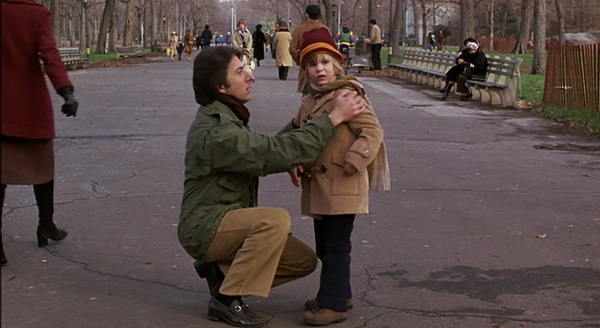
To recap: the film is about a workaholic father, Ted Kramer (Dustin Hoffman), whose high-flying Manhattan advertising job pays him the heady salary of $34,000 a year. (for realz) and who has no idea that his wife Joanna (Meryl Streep, in her first big role) is desperately unhappy. He comes home to find her checking out of the marriage, leaving him in the care of their 7-year-old Billy. Naturally Ted has no clue what to do, doesn’t know the first thing about parenting, and isn’t even sure what grade Billy is in at school. He’s angry and resentful, while his son is frustrated with his father’s ineptitude and impatience.

Over time, Ted finds a groove, he and Billy bond, and he realizes his child is the center of his world, even losing a job over it. (The movie’s best scene is where Ted, in a very Hoffmanesque way, demands that another firm hire him on the spot during a holiday party.) A year passes and Joanna returns, demanding custody of Billy. The parties go to court, fight it out, and Ted loses the case. In a final twist, Joanna decides she doesn’t want to uproot Billy from his home and allows Ted to have primary custody.
In our current political context, Kramer would be termed a “men’s rights” movie or some such. But really, this movie wouldn’t exist in our current climate. For one thing, society has evolved beyond the simple binary construct the film presents. For another, few today suggest men (straight or gay) cannot be attentive, loving parents. In fact, the culture has shifted to support that, in what we all call “work-life balance” now.
And, despite the film’s best efforts to sympathize with Joanna—something that Streep apparently had a great deal to do with—she still ends up the antagonist. I suspect that would fly less well today than it did in ’79.
I had seen the movie several times—although probably not in 20 years at least, if not longer—and remember most of the beats. It’s a terrific film, and while I know Hoffman is not a viewed charitably now for his behavior back in the day, he and Streep both knock it out of the park. The film won a bevy of awards.
What I wasn’t prepared for was how much it moved me.
As Ted’s dilemma unfolded, I first flashed back to the early days of my solo parenting experience: rising early in the morning, rousing my toddler out of her tiny bed, getting her fed, getting her dressed, in the stroller, onto the Metro, off to daycare. These were singular times, when I felt, like Ted, that I had only one priority in my life. That was a feeling that lasted for years. And at times, I still miss those days for their sense of necessity and clarity. (Although I like to think I never allowed my daughter to climb a jungle gym while holding a large toy airplane, as Ted does in the film with terrible consequences.)
But this is not to paint myself as a hero. I was not by any means. And the truth is that as Kramer progressed to its end, I realized that I was less Ted than Joanna. After all, I was not the primary parent. And I made the same tearful choice that Joanna made at the end of the film. I had decided my daughter needed a stable, regular home—and that home, at least then, was not with me. So I became the minority partner in the operation. I would get to see my girl two, maybe three days a week at most, but I would end up missing a large chunk of her life along the way.
It’s a decision I have revisited often, and I have wondered whether my motives were pure or instead an excuse so I could pursue my professional path or be unburdened by everyday parenthood. I don’t know the answer. All I know is that my daughter, so far at least, has turned out about as well as anyone could ask (to the great credit of her mother). She does not view me as the minority partner, even if I may see myself that way. To her, there is nothing to forgive. I can only hope that remains the case.

Parenting also lies at the core of The Killing, a four-season series that originally ran on AMC and now can be found on Netflix. I missed it the first time around and have been catching up. It’s a gloomy, Scandinavian-style police procedural set in Seattle, and I can’t say it’s an especially excellent piece of work. (Its first season is its weakest and drove viewers away.)
But the show has something to say about parents and their kids. The first two seasons involve a missing teenage girl, a secret life, and the effect tragedy has on a family. The third season, however, is the series’ apex, as its two detectives become snared in a case that involves Seattle’s “lost” children who live on the street. The teens are well realized—fierce, protective, loving, but also, of course, highly damaged and adrift, victims of parents who had no idea how to parent. Their fates, mostly, are heart-breaking. Season Four concerns how parental neglect can transform boys into monsters.

The show’s most complex parent, however, is the series lead, Sarah Linden, as played by Mireille Enos. Enos gives Linden a grating unlikeability. You never warm up to her even as you admire her dedication and empathize with her own deep-seated pain. (She grew up in the foster system, without a stable home.) Linden is also, by almost any standard, a terrible mother to her teenage son. She is driven to her job to the point of neglect—a trope in most TV series that is held by a man. The series does not romanticize this; Linden is a modern antihero in that her choices aren’t uniformly correct or even smart. She makes mistakes. She becomes overwhelmed. She fails. The thread that runs through the show is that bad parents beget bad parents–and breaking that chain is harder than it seems, something personified in the show’s last season by the impending fatherhood of Linden’s partner, Stephen Holder (Joel Kinnaman).
At the end of the first season, Linden is given a defining moment : She can either keep trying to reconcile being an obsessive detective with being a parent or turn the kid over to his father. She, somewhat surprisingly, chooses the latter. It’s another version, of course, of the decision made by Joanna Kramer and, in a sense, by me, all premised on what is best for the child. Still, it’s hard to escape the feeling that the rationalization is a cop-out and a bit of a surrender.
We never see Joanna again after the elevator door closes in Kramer‘s final shot, but I wonder how many empty nights she spent regretting her choice. —James Oliphant
 The VCR